
The card
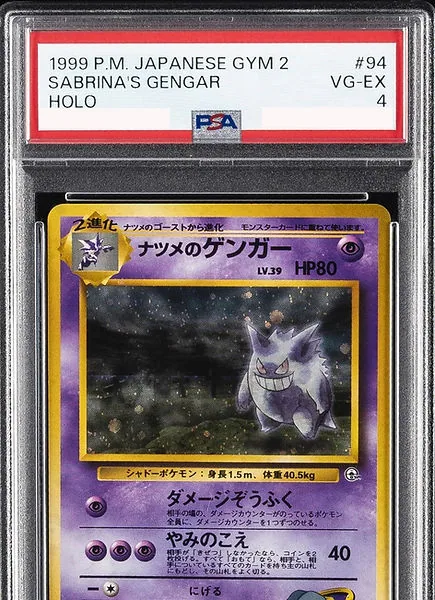
This is the 1999 Japanese Gym 2 Sabrina's Gengar, card No. 94, a holographic card, restored at CardRevive. The card came in creased, and needed corner correction and dent repairs.
This case is published with the card owner's permission. As with every CardRevive case study, any certification number is withheld to protect the owner's privacy.
The two grades
Before restoration the card was graded PSA VG-EX 4, Very Good-Excellent on PSA's scale. After restoration it was graded TAG GEM MINT 10, Gem Mint on TAG's scale. Those two grades come from two different grading companies, so the six-point difference is not a like-for-like, same-scale comparison. It is the largest grade lift CardRevive has on record, but it crosses grading houses to get there.
On the bench
CardRevive's standing policy is assessment-led work: a card is physically assessed, and the proposed service and price are presented for approval before treatment begins. The exact products and steps are trade-confidential and scoped per card, so this page describes the documented outcome rather than a method, and it contains no repair instructions.
The result in context
The documented outcome is the largest grade lift CardRevive has on record: six points, from a PSA 4 to a TAG 10. Across the bench, most cards CardRevive treats see a one to three point grading lift, with up to six points on record for the exceptional cases like this one.
The grade itself was the grading house's decision. A six-point lift across two different companies is a high point, not a baseline, and it is not a promise attached to the next card.
The honest part
What a case study can and cannot promise
Any work on a card is technically alteration. We restore and conserve, we never recolour, and we never sell work as undetectable.
The grade belongs to the grading house. PSA, BGS, PCG, ACE and CGC each apply their own current standards to the physical card and make the final call. No grade is ever guaranteed, and a past result never promises the next one.
Disclosure travels with the card. If you later sell or resubmit it, describing the work honestly to the buyer, marketplace or grading house is your call as the owner. CardRevive keeps private before-and-after records and helps you make that disclosure accurately.